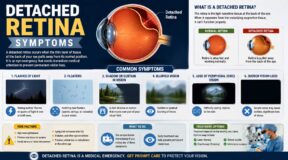
Sudden flashes of light, a rapid increase in eye floaters, or a dark curtain moving across your vision can be retinal detachment symptoms. A retinal detachment is a medical emergency because the retina has separated from the tissue that normally supports it. Although the condition itself usually does not cause eye pain, it can threaten permanent vision if treatment is delayed. Therefore, anyone who develops new warning signs should seek urgent evaluation by an eye-care professional rather than waiting to see whether the symptoms disappear.
The symptoms can vary depending on the location and extent of the detachment. However, knowing the classic warning signs makes it easier to recognize when an ordinary visual change may require immediate medical attention.
What Is a Retinal Detachment?
The retina is a thin layer of light-sensitive tissue at the back of the eye. It receives light and converts visual information into signals that travel through the optic nerve to the brain.
When the retina separates from the underlying tissue, its normal function becomes disrupted. As a result, parts of the visual field can become blurred, distorted, dark, or missing.
A retinal detachment can develop suddenly. However, some people first develop a retinal tear, which may allow fluid to pass underneath the retina and cause it to separate.
Because the condition can progress, prompt diagnosis matters. Treatment generally works best when doctors can repair the problem before more of the retina becomes detached, particularly before the central retina, called the macula, becomes involved.
What Are the Main Retinal Detachment Symptoms?
The most recognizable retinal detachment symptoms involve sudden changes in vision rather than discomfort. In fact, many people have no eye pain at all.
Common warning signs include:
- A sudden increase in floaters
- Flashes of light, often in the side of the visual field
- A shadow appearing in part of the vision
- A curtain or veil moving across the visual field
- Reduced peripheral vision
- Blurred or distorted vision
- Loss of vision in part of one eye
The symptoms often occur in only one eye. However, having retinal problems in one eye may indicate a need for careful evaluation of both eyes.
People sometimes describe detached retina symptoms as seeing small dots, cobweb-like shapes, specks, or flashing lights before noticing a shadow in their vision. Although these visual changes can have other causes, sudden new symptoms deserve urgent assessment.
Floaters as an Early Warning Sign
Floaters are small shapes that appear to move through your vision. They may resemble dots, threads, cobwebs, rings, or small dark spots.
Many people have occasional floaters, particularly as they get older. Therefore, having a few longstanding floaters does not automatically mean the retina is detaching.
The concern is a sudden change.
For example, you may suddenly notice many more floaters than usual. Some people describe the appearance as a shower of small spots.
A sudden burst of floaters can occur when changes in the vitreous gel inside the eye pull on the retina. In some cases, that process can create a retinal tear.
Therefore, a sudden increase in floaters, especially when combined with flashes of light, should be evaluated promptly.
Flashes of Light and Retinal Detachment
Another classic symptom is seeing brief flashes of light, sometimes called photopsia.
These flashes may resemble lightning streaks, sparks, or camera flashes. They often appear toward the edge of the visual field and may become more noticeable in dim lighting.
Although not every flash means a retinal tear or detachment has occurred, new or sudden flashes need medical attention, particularly when accompanied by new floaters.
The Curtain or Shadow Warning Sign
Among the more concerning signs and symptoms of retinal detachment is the appearance of a dark curtain, veil, or shadow across part of the visual field.Alternatively, a person may simply notice that a section of their visual field is missing.
This symptom requires emergency medical assessment.
Do not wait for pain, because retinal detachment is often painless. Likewise, do not wait until the following day to see whether vision returns to normal.
The location of the shadow does not reliably tell you how serious the condition is. Therefore, any sudden loss or obstruction of part of the visual field deserves immediate attention.
Blurred Vision and Loss of Central Vision
Blurred vision has many possible causes, ranging from refractive errors to eye disease. However, sudden blurred vision occurring alongside flashes, floaters, or a visual-field shadow can be associated with retinal detachment.
Vision may become increasingly unclear as the affected area expands.
If the detachment reaches the macula, which provides detailed central vision, the ability to see fine detail can decline significantly. Reading, recognizing faces, or seeing objects directly ahead may become difficult.
Because progression can vary from person to person, there is no safe amount of time to wait after suspicious symptoms begin. Questions about how long before retinal detachment causes blindness do not have one fixed answer, since the speed and severity depend on factors such as the location and extent of the detachment.
For that reason, suspected retinal detachment should be treated as urgent rather than monitored at home.
Symptoms Retinal Detachment May Cause Without Pain
One reason people delay seeking treatment is that they expect a serious eye problem to hurt.
However, retinal detachment usually does not cause pain.
The retina itself does not respond to injury in the same way as pain-sensitive structures elsewhere in the body. Therefore, a person can experience a serious visual emergency while the eye otherwise feels normal.
Likewise, the outside of the eye may not look noticeably different.
Consequently, the absence of redness, swelling, or pain should never reassure someone who has suddenly developed flashes, numerous new floaters, a curtain-like shadow, or visual-field loss.
What Causes a Retinal Detachment?
Several mechanisms can cause the retina to separate.
The most common type is rhegmatogenous retinal detachment. It occurs when a tear or break develops in the retina and fluid passes through the opening, collecting underneath it.
Another form, tractional retinal detachment, occurs when scar tissue on the retinal surface contracts and pulls the retina away from the back of the eye. This type can occur in people with certain retinal diseases, including advanced diabetic eye disease.
Exudative retinal detachment develops when fluid accumulates underneath the retina without a retinal tear. Inflammation, tumors, vascular problems, and other conditions can sometimes contribute.
Because the causes differ, an eye specialist needs to determine what is happening before recommending treatment.
Who Has a Higher Risk?
Retinal detachment can happen to anyone, but certain factors increase the likelihood.
Risk factors can include:
- Older age
- Severe nearsightedness
- Previous retinal detachment in the other eye
- A family history of retinal detachment
- Previous eye surgery, including cataract surgery
- Significant eye injury
- Certain retinal disorders
- Areas of retinal thinning
- Some complications of diabetic eye disease
Age-related changes in the vitreous are a common reason people develop new flashes and floaters. As the vitreous naturally changes and separates from the retina, it can occasionally pull hard enough to create a retinal tear.
Still, having a risk factor does not mean retinal detachment will definitely occur. Instead, it means recognizing sudden visual changes becomes especially valuable.
How Doctors Diagnose Retinal Detachment
If you report possible symptoms of retinal detachment, an eye specialist will typically examine the retina carefully.
A dilated eye examination allows the doctor to inspect the back of the eye for retinal tears, holes, bleeding, or detached areas.
The doctor may use specialized instruments to view different parts of the retina. In some situations, ultrasound imaging can help when blood or another obstruction makes the retina difficult to see directly.
Other imaging techniques may also be used depending on the clinical situation.
The goal is not only to confirm whether a detachment exists but also to determine its location, size, cause, and whether the macula is affected.
How Retinal Tears and Detachments Are Treated
Treatment depends on whether the retina has a tear without detachment or has already separated.
Doctors can sometimes seal a retinal tear using laser treatment or cryotherapy, which uses freezing treatment around the tear. These procedures aim to create a barrier that helps prevent fluid from passing through the break and causing detachment.
Once the retina has detached, surgery is commonly required.
Possible procedures include pneumatic retinopexy, scleral buckle surgery, and vitrectomy. The appropriate procedure depends on the characteristics of the detachment and the patient’s individual situation.
Sometimes, doctors combine techniques.
Recovery and visual outcome vary. Therefore, your ophthalmologist can give more meaningful guidance after examining the retina and determining how much of it is affected.
When Should You Seek Emergency Medical Care?
Seek urgent eye care if you suddenly develop:
- Numerous new floaters
- New flashes of light
- A dark curtain or veil in your vision
- A growing shadow in the visual field
- Sudden loss of peripheral vision
- Sudden unexplained vision loss
- A combination of flashes, floaters, and blurred vision
If these symptoms occur, contact an ophthalmologist or emergency eye service immediately. If urgent eye care is not directly available, seek emergency medical attention.
Do not drive yourself if your vision has suddenly become impaired. Instead, arrange safe transportation or use emergency services when appropriate.
Even if the symptoms improve temporarily, medical evaluation is still necessary because a retinal tear or detachment does not become harmless simply because a visual disturbance seems less noticeable.
Can Retinal Detachment Be Prevented?
Not every retinal detachment can be prevented. However, people at increased risk can take practical steps to protect their vision.
Attend recommended eye examinations, particularly if you have severe nearsightedness, diabetes, previous retinal problems, or a history of eye surgery.
Likewise, use appropriate protective eyewear during activities that could cause eye injuries.
If you already know that you have retinal thinning or another retinal condition, follow your ophthalmologist’s recommended monitoring schedule.
Most of all, learn the warning signs. Recognizing sudden flashes, new floaters, shadows, or visual-field loss can help you seek care quickly if a retinal problem develops.
Frequently Asked Questions
What are symptoms of retinal detachment at the beginning?
Early symptoms may include a sudden increase in floaters and new flashes of light. However, symptoms vary, and some people may notice a shadow or visual-field change. Therefore, sudden new visual symptoms require prompt professional evaluation.
Does retinal detachment hurt?
Usually, retinal detachment is painless. Therefore, lack of pain does not mean the problem is minor.
Can retinal detachment happen suddenly?
Yes. Symptoms can appear suddenly, especially when a retinal tear develops and fluid begins moving beneath the retina. However, the rate of progression varies.
Are eye floaters always a sign of retinal detachment?
No. Floaters are common and often have causes unrelated to retinal detachment. However, a sudden increase in floaters, particularly with flashes or a shadow in your vision, needs urgent evaluation.
Can retinal detachment heal by itself?
A retinal detachment should not be expected to heal on its own. Treatment is generally needed to repair the retinal problem and reduce the risk of further vision loss.
Can you still see with a detached retina?
Yes, depending on the location and extent of the detachment. A person may initially retain much of their vision while losing only part of the visual field. However, the condition can progress, so preserved vision is not a reason to delay treatment.
What to Do If You Notice Warning Signs
Retinal detachment is one situation where waiting for symptoms to become severe can put vision at unnecessary risk. Therefore, if you suddenly see flashes, develop many new floaters, notice a dark curtain or shadow, or lose part of your visual field, seek urgent eye care.
Although many visual symptoms can have causes other than retinal detachment, only a proper eye examination can determine what is happening. Prompt assessment can identify retinal tears or detachment early and allow an ophthalmologist to recommend the appropriate treatment.