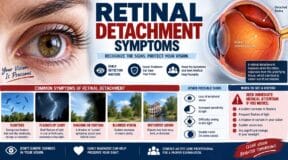
Sudden flashes of light, a burst of new floaters, or a dark shadow moving across your vision can be alarming. These can be detached retina symptoms, and they require urgent medical attention because retinal detachment can threaten permanent vision. It usually does not cause eye pain, so knowing the visual warning signs is especially useful. If you suddenly develop symptoms that could indicate retinal detachment, contact an eye doctor or seek emergency eye care right away rather than waiting to see whether they disappear.
The retina is a thin layer of light-sensitive tissue at the back of the eye. When it separates from the tissue beneath it, retinal cells can lose access to the oxygen and nutrients they need. Therefore, prompt diagnosis and treatment can make a major difference in protecting vision.
What Is a Detached Retina?
A retinal detachment happens when the retina pulls away from its normal position at the back of the eye. Since the retina converts light into signals that travel to the brain, a detachment can interfere with how you see.
Several forms of retinal detachment exist. The most common type, rhegmatogenous retinal detachment, develops when a tear or break in the retina allows fluid to pass underneath it.
Tractional retinal detachment occurs when scar tissue pulls the retina away from the back of the eye. Meanwhile, exudative detachment develops when fluid collects beneath the retina without a retinal tear.
Regardless of the type, suspected retinal detachment needs professional assessment. Home remedies cannot reattach a retina.
Detached Retina Symptoms to Watch For
The symptoms of a detached retina can develop suddenly. However, some people notice warning signs before a larger portion of the retina separates.
Sudden Increase in Eye Floaters
Floaters are small spots, threads, cobweb-like shapes, or specks that appear to drift through your field of vision. Many people have harmless floaters, particularly as they get older.
However, a sudden shower of new floaters is different. You may notice many small dots appearing at once or a new large floater that was not present before.
Sometimes, this happens when the vitreous gel inside the eye pulls away from the retina. Although this age-related process does not always cause retinal detachment, it can occasionally create a retinal tear.
Therefore, a sudden change in floaters deserves prompt evaluation, especially when flashes or changes in vision occur at the same time.
Flashes of Light
Another classic warning sign is seeing brief flashes of light, often called photopsia.
The flashes may resemble lightning streaks, sparks, or camera flashes. They commonly appear toward the side of the visual field and may be more noticeable in dim surroundings.
These flashes can happen when the vitreous pulls or tugs on the retina. While flashes have several possible causes, sudden new flashes combined with new floaters need urgent assessment.
A Dark Curtain or Shadow Across Vision
A dark curtain, veil, or shadow moving across part of your visual field is one of the most concerning detached retina symptoms.
For example, you might notice that part of your peripheral vision appears missing. As the detachment progresses, the shadow may spread across a larger area.
This symptom should never be monitored at home to see whether it improves. Instead, seek urgent eye care.
People understandably wonder how long before retinal detachment causes blindness, but there is no safe waiting period that applies to everyone. The speed and extent of vision loss depend on factors such as the location and progression of the detachment, so suspected symptoms should be treated as an eye emergency.
Other Symptoms of Detached Retina
Retinal detachment does not always begin with exactly the same experience. Consequently, recognizing other changes can help you respond quickly.
Blurred or Reduced Vision
Vision may suddenly become blurry or less sharp. For instance, reading text may become difficult, or objects may appear less clear than they did earlier.
However, blurred vision has many possible causes, ranging from refractive errors to other eye conditions. Therefore, blurred vision alone does not prove that your retina has detached.
Still, sudden blurred vision combined with flashes, floaters, or a shadow should raise concern.
Loss of Peripheral Vision
Peripheral vision allows you to notice objects outside the center of your gaze. As a retinal detachment spreads, part of this side vision can disappear.
You may initially notice a shadow coming from one side rather than complete loss of sight.
Because the change can begin at the edge of vision, some people may not immediately recognize how serious it is.
Distorted Vision
Straight lines or familiar objects may sometimes appear distorted, particularly if the central retina becomes affected.
Likewise, visual clarity can decrease as the detachment approaches or involves the macula, the central part of the retina responsible for detailed vision.
Any sudden distortion or loss of central vision requires urgent professional evaluation.
Quick Guide to Detached Retina Symptoms
The following table can help you recognize changes that warrant medical attention. However, it cannot diagnose retinal detachment.
| Visual change | What it may feel or look like | What to do |
|---|---|---|
| Sudden new floaters | Spots, dots, threads, or cobwebs | Seek prompt eye evaluation |
| New flashes | Sparks or lightning-like streaks | Contact an eye-care professional urgently |
| Dark curtain or shadow | Part of vision becomes blocked or dark | Seek emergency eye care |
| Peripheral vision loss | Missing vision from one side | Seek emergency evaluation |
| Sudden blurred vision | Unexpected reduction in visual clarity | Get urgent medical assessment |
| Sudden visual distortion | Lines or objects appear altered | Seek prompt professional care |
If several of these changes occur together, the need for rapid assessment becomes even stronger.
Do Detached Retina Symptoms Cause Pain?
Retinal detachment is typically painless. As a result, people sometimes underestimate the seriousness of their visual symptoms.
You may have no redness, soreness, or obvious injury. Yet a significant retinal problem can still be developing inside the eye.
Therefore, lack of pain should never reassure you when sudden flashes, numerous new floaters, a curtain-like shadow, or loss of vision occurs.
Likewise, taking pain medicine will not address the underlying problem because retinal detachment requires eye-specific diagnosis and treatment.
Detached Retina Symptoms Pictures: Can Images Help You Identify It?
People often search for detached retina symptoms pictures because they want to compare their vision with examples online. Illustrations can help explain concepts such as floaters or a curtain-like visual-field defect, but pictures cannot confirm whether your retina is detached.
The same visual symptom can have several possible causes. Meanwhile, the appearance of symptoms can differ from person to person.
An eye specialist needs to examine the retina directly to determine what is happening. Therefore, do not delay medical care while comparing your vision with online photographs or diagrams.
What Causes a Retinal Detachment?
Age-related changes in the vitreous are a common pathway leading to retinal tears and detachment. As people age, the gel-like vitreous inside the eye changes and may separate from the retina.
Usually, this separation occurs without serious complications. However, the vitreous can sometimes pull hard enough to tear the retina. Fluid may then move through that opening and separate the retina from the tissue underneath.
Other mechanisms include scar tissue pulling on the retina or fluid accumulating beneath it.
Because several processes can lead to detachment, the treatment depends partly on the underlying type.
Who Has a Higher Risk?
Retinal detachment can happen to anyone, although certain factors raise the risk.
For example, risk may be higher in people with severe nearsightedness, previous retinal detachment in the other eye, a family history of retinal detachment, certain eye injuries, or previous eye surgery such as cataract surgery.
Certain retinal conditions can also increase risk. Meanwhile, diabetic eye disease can cause scar tissue that may contribute to tractional retinal detachment.
Having a risk factor does not mean you will develop the condition. However, knowing your risk can make it easier to recognize why sudden visual changes deserve prompt attention.
How Doctors Diagnose a Detached Retina
An eye-care professional usually evaluates the retina through a dilated eye examination.
After dilating the pupil, the clinician can examine the back of the eye and look for retinal tears, holes, fluid, or areas of detachment.
In some situations, imaging or ultrasound may help when the retina cannot be seen clearly, such as when bleeding blocks the view.
Diagnosis should happen as quickly as practical when symptoms suggest a retinal tear or detachment. Therefore, describe exactly when your symptoms started and whether they are changing.
How Is a Detached Retina Treated?
Treatment depends on whether there is a retinal tear, the type and extent of detachment, its location, and other characteristics of the eye.
A retinal tear that has not yet progressed to detachment may sometimes be sealed using laser treatment or freezing therapy, known as cryopexy.
When the retina has detached, surgery is usually needed. Procedures can include pneumatic retinopexy, scleral buckle surgery, or vitrectomy.
Pneumatic retinopexy uses a gas bubble placed inside the eye to help push the retina back into position in selected cases. Meanwhile, a scleral buckle places material around the outside of the eye to support the retinal wall. Vitrectomy removes vitreous gel and may use gas or silicone oil to help keep the retina in place.
The ophthalmologist chooses treatment according to the individual condition rather than using one procedure for everyone.
Symptoms Before and After Detached Retina Treatment
People searching for symptoms before and after detached retina treatment often want to know whether vision immediately returns to normal.
Before treatment, symptoms may include floaters, flashes, shadows, missing areas of vision, or blurred sight. After surgery, however, recovery varies considerably.
Vision may remain blurry for some time. If a gas bubble was placed in the eye, it can temporarily affect what you see while it gradually disappears.
Your surgeon may also give specific instructions about head positioning, physical activity, medications, follow-up appointments, and air travel. In particular, flying or traveling to high altitude can be dangerous while certain intraocular gas bubbles remain because reduced atmospheric pressure can make the gas expand.
Therefore, follow your surgeon’s individual instructions rather than relying on general recovery advice.
Can Retinal Detachment Be Prevented?
Not every retinal detachment is preventable. However, protecting your eyes and responding quickly to warning signs can reduce avoidable risks or help catch retinal problems earlier.
Wear suitable protective eyewear during activities where eye injuries are possible. Likewise, attend recommended eye examinations if an eye-care professional considers you at increased risk.
If you have diabetes, managing your condition and attending recommended retinal examinations can also help identify diabetic eye disease before severe complications develop.
Most of all, learn the warning signs. Early evaluation of a retinal tear may sometimes allow treatment before it develops into a larger detachment.
Common Myths About Retinal Detachment
“If my eye doesn’t hurt, it can’t be serious.”
This is false. Retinal detachment is usually painless, despite being a vision-threatening emergency.
“Floaters always mean my retina is detached.”
No. Floaters are common and often harmless. However, a sudden increase in floaters, especially alongside flashes or visual-field loss, needs prompt assessment.
“I can wait until tomorrow if the shadow is small.”
Waiting can put vision at risk. A new curtain, shadow, or missing area of vision requires urgent eye care.
“Online symptom pictures can tell me whether I have it.”
They cannot. Only an appropriate eye examination can diagnose a retinal tear or detachment.
FAQs About Detached Retina Symptoms
What are the first symptoms of a detached retina?
Common early warning signs include sudden new floaters and flashes of light. A shadow or curtain may appear as retinal detachment develops or progresses.
Can retinal detachment happen suddenly?
Yes. Symptoms can appear suddenly, and vision may worsen as the detachment progresses. Therefore, sudden suspicious visual changes require urgent assessment.
Does a detached retina cause a headache?
Headache is not considered a typical defining symptom of retinal detachment. Since headaches and visual symptoms can have many causes, seek medical evaluation when new or severe symptoms occur.
Can you have a detached retina and still see?
Yes. A detachment may initially affect only part of the visual field. Therefore, having some normal vision does not rule it out.
Can retinal detachment heal on its own?
A detached retina requires medical treatment and should not be expected to reattach on its own. If you suspect a detachment, seek urgent professional care rather than trying home treatments.
What to Do If You Notice Warning Signs
Knowing the symptoms of a detached retina matters because treatment is time-sensitive. Therefore, treat sudden flashes, a burst of new floaters, a dark curtain or shadow, peripheral vision loss, or sudden unexplained vision reduction as reasons to seek urgent eye care.
Do not drive yourself if your vision is significantly affected. Instead, arrange safe transportation to an ophthalmologist, emergency eye service, or emergency department as appropriate in your area.
Most of all, do not wait for pain. Retinal detachment can be painless, yet it can still threaten sight. Prompt professional assessment gives you the best opportunity to identify the cause and receive appropriate treatment quickly.